標籤:
華利,
戲如人生
In early 1980s, computers were still regarded as large machines processing electronic data. The ‘electronic data processing’ was a popular term, which reflected how people perceived computers at that time. In 1984, Macintosh computer was introduced, and marked the breakthrough of personal computer technology. It promoted the idea of ‘user-friendly’, by virtue of graphical user interface, eradicating entering complicated text commands to make computer do things. The model, concept and the habit of using a personal computer today, such as operating through GUI with a mouse in addition to a keyboard, was originated from the standard of this first Macintosh computer introduced. The easiness of operating a computer helped to speed up the development of the technological and information age in the coming 20 years. Today the term ‘electronic data processing’ is rarely used, and is replaced by ‘information technology’, to reflect the change in the concept of how computers are used - they are small, or even portable, and become vital tools for our work, study and even daily life. Not only we can process data, but also search and present information, and refine information to our knowledge with computers. The data or information do not confine to text, and also multi-media. We can get entertainment from computers, which poses a threat to traditional media business, such as TV, radio, and music and film industry. The early 1980s, therefore, marked a historial moment of the technological and information age we now experience.
People at that time could foresee that the coming of technological and information age, which was pushed by the technological revolution of personal computer. At the same time they seemed having much doubts and fears about how the society would change. Such doubts and fears were represented by some science fiction films, such as Bladerunner , which illustrated a ‘high tech’ but ‘low life’ city. Even entering the early 1990s, the making of the animation series Wallace and Gromit still shared similar concerns, such as the reliability and the misuse of technologies, which could in turn become crisis for human beings.
In this article, I’d like to study how people in the early 1980s perceived the technological and information age coming, in a sense of fear and crisis, from the analysis of a science fiction film, Brazil , released in 1985. After 20 years, when seeing the film today , people may find Brazil some how predicted some changes which really happen now. It would be interesting to see why people at that time could think of the changes happened today, and also the changes they guessed wrong or missed.
Background and synopsis of Brazil
Brazil was filmed by Terry Gilliam, and its screenplay was written by him, Tom Stoppard and Charles McKeown. There were 3 versions during the theatrical release of the film. The version to which I refer in this article is the 142-minute director’s cut. It is the version which followed the author’s original idea of making this film.
A s what the caption said ‘somewhere in the 20th century’ in the opening of the film , Brazil was set in sometime of 20th century, and the location seemed to be a high-tech or ‘cyberpunk’ city, with information easily accessible, and fully electronic automation of home and office. The main character Sam Lowry, worked in the Ministry of Information (MOI), met his dream girl Jill Layton when she reported a mistaken arrest of her neighbour as a terrorist by MOI. Jill was pursued and in danger since the authority wanted to hide the mistake made. Sam tried to rescue her but failed, and was finally underwent ‘frontal lobotomy’ by the authority.
Information and power
Gilliam revealed that the film was inspired by George Owell’s 1984 , and the working title of the film was 1984 1 / 2 . Owell’s 1984 was a novel, published in 1949, of 3-part story: ‘The first part deals with the world of Nineteen Eighty-Four as seen through the eyes of Winston; the second part deals with Winston's forbidden sexual relationship with Julia and his eagerness to rebel against the Party; and the third part deals with Winston's capture and torture by the Party’ (Wikipedia: Nineteen Eighty-Four). The structure and the story of Brazil are much alike those of 1984 , as what Gilliam said, ‘written from today’s perspective’ (Wikipedia: Brazil).
Gilliam replaced the ‘Party’ of 1984 with ‘Ministry of Information’ in Brazil . We can see that people often relate ‘power’ with ‘who control the information’ in the information age or cyberspace. Barker cites Touraine that ‘the dominant class is that group able to access and control information’, and we will have ‘technocrats and bureaucrats counterpoised to workers, students and consumers’ (Barker 2003: 162). In the film, the head of MOI was the Deputy Minister named Helpmann. MOI was a large bureaucratic itself, had its security team and weapons, and c ould interrogate any suspects without any formal reason and explanation.
The relation among several characters in the film showed such ‘power-information’ connection. Sam’s first boss Kurtzmann trusted and depended on Sam very much, since Sam knew how to use computer to solve various problems for him. Sam was the son of a late senior information official, who was the Deputy Minister Helpmann’s good friend. Sam’s mother, despite she did not work in MOI, could request getting Sam promoted as she liked. Sam’s relatives and friends often told Sam going to see a doctor since he rejected the promotion. Sam’s mother got respected everywhere while Sam, since he was not promoted and not well known, was often rudely inspected in restaurant and party, until her mother told them he was her son.
We can see from the film that, after entering the technological information age, the authority and corporation were ‘centralized’, e.g. Central Services, Central Computer, Central Banking. As Mosco suggests, ‘power sets the pattern for the principal direction of production, distribution, and use [of technology]’ (Mosco 1988). Why the author of the film suggested a ‘centralized’ structure for the authority and the corporation in the information age, is that it facilitated the collection of capital and the surveillance.
But from today’s development of information technology, we can see a very different picture of social structure: a community-based relationship exists in the cyberspace without central control . People can do anything they like once they connect to the Internet, without much worries of the interference from the authority. Even some governments exercise content filtering, people can still find ways to pass through the roadblock. Gilliam and others in 1980s might overlook the technology of network, or later, the Internet, which was not known by ordinary people at that time.
Bell cites Porter that ‘the aim of current systems of power is to make people accessible to computers (rather than vice versa), since computers are “perfect” disciplinary (and disciplined) machines’ (Bell 2001: 84). Therefore ‘computers do the work of supervision (or surveillance) ... also produce three other effects of discipline ...’ (Bell 2001: 85).
A surveillance society
The city presented in the film showed us how people thought a surveillance society would look like in the coming technological and information age, or, in the urban space built up from cyberspace. Apart from the robots with cameras, connected to a CCTV system, monitoring peo ple, the author imagined that the ducts (or, wires and cables) were everywhere, penetrated deeply through the physical infrastructure, home and the office. At the beginning of the film, commercials were showed to emphasize the importance of the ducts in daily life. The information, in the form of papers and documents, were transferred through the ducts, without the need of human interference. Another use of ducts was for air-conditioning, and also other automatic devices installed at home and in the office. It was illegal for people to reapir those ducts or the devices without the permission of Central Services, a market-dominated corporation, which might be related to the authority. Another character Harry Buttle was regarded as terrorist, since he provided service repairing those devices himself. Audience could see ducts everywhere in the film, being an outstanding symbol for the devices and tools facilitating authoritarian surveillance.
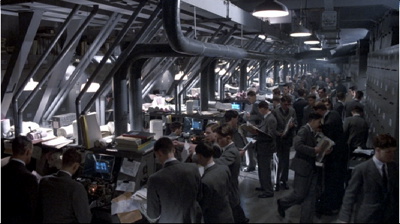
People often thought that technological and information age assumed a highly surveillance society coming , even in the ‘Western’ capitalist world in 1980s. Robins and Webster believe that, by citing Focault’s concept of panopticon - ‘a machine that ensures the infinitesimal distribution of power, one that turns the monitored individual into a visible, knowable, and vulnerable object ’ - ‘on the basis of “information revolution”, ... the social totality ... comes to function as the hierarchical and disciplinary [p]anoptic machine’, and so ‘we can see that a technological system is being constituted to ensure the centralized, and furtive, inspection, observation, surveillance, and documentation of activities on the circumference of society as a whole’ ( Robins and Webster 1988). Apart from the ducts mentioned before, there was a dialogue repeated several times, ‘you can’t move without a form’. People in the city presented by the film had to fill in different types of paper forms in order to do almost anything, for t he authority could control people’s daily life as far as possible . Volumes of paper forms were then processed by computers, with the help of large number of people working in different departments of MOI. At the beginning of the film, a moving shot showed the MOI department for which Sam worked, which was a gigantic office, messed around by countless staff. The complicated form-filling surveillance, also contributed to the formation of the bureaucratic, the MOI, in the story. Such form-filling surveillance also had the panopticon effect, expressed by an exaggerated humorous scene, in which after Sam asked the 2 Central Services technicians whether they filled the forms required or not, the technicians were in panic reflexively since they did not. In fact, almost any character was highly alert when he or she did not want others know what they did. For instance, Sam’s first boss Kurztmann had to make sure nobody tapping in his own office, even there seemed no tapping he still dared not talk very loud with Sam about his troubles.

Brazil: a gigantic office, messed around by countless staff
In mid-1980s, the development of Structured Query Language (SQL), the syntax widely used to manipulate database today, became standardized and improved. Today’s use of SQL in almost any database application was based on the version released in 1992. 1980s was the period when the effectiveness of database quickly improved. People at that time could already conclude that we would live together with database in the coming years. Poster claims database as a ‘super-panopticon’, which ‘[i]n its electronic and digital form, the database is perfectly transferable in space, indefinitely preservable in time; it may last forever everywhere’, and ‘is no one’s and everyone’s yet it “belongs” to someone, to the social institution that “owns” it as property ...’. So ‘[t]he database is a discourse of pure writing that directly amplifies the power of its owner/user’ (Poster 1995: 85). It ‘transform[s] our acts into an extensive discourse of surveillance, our private behaviours into public announcements, our individual deeds into collective language’ (Poster 1995: 87). Database was not explicitly specified in the film, and was an invisible but the most valuable facility. The department processing database information had more power than the one entering data. With the information retrieved in the database, people could be interrogated without knowing being pursued and their actions recorded. For instance, Jill was quickly known for its witness of mistaken arrest by various characters after accessing the central database record.
A consumer society
In a scene there was a boy answering Santa Claus that he wanted a credit card as his Christmas gift. Gilliam predicted our capitalist way of life would perpetuate in the technological and information age. Robins and Webster claim, with Garnham’s perspective of political economy, that ‘[t]he function of new technologies “to develop the market for so-called information goods and services as a new growth sector” that expresses both “the needs of the corporate sector for enhanced communications facilities and the increasingly desperate national search for a share of the international market in high technology products.”’ (Robins and Webster 1988). P eople in 1980s, in fact, already kn e w the economic value of information, such as financial data. W hen the society enters information age, in which having information means having more profit or even power, a ‘pay-per society’ stated by Mosco (1988) will emerge. Mosco suggests that ‘new technology makes it possible to measure and monitor more and more of our electronic communication and information activities ... business and government see this potential as a major instrument to increase profit and control’, which results in ‘pay-per society’ (Mosco 1988) . Such observation could be reflected by the beginning of the film, in which, as the authority dominated the information collection and retrieval, Helpmann was interviewed and talked about ‘information retrieval charge’. Every time if MOI was involved in handling application or operation, the people had to be charged. When Sam was interrogated after he tried to rescue Jill but failed, not only the officials asked him many questions, also the legal and insurance counterparts promote their services which could suit Sam’s need. It was possible since those counterparts could get relavent information from MOI easily and quickly .
The surveillance stated before not only helped monitoring public activities, as showed in the film, also acted as a way to promote physical goods and products. TV still appeared everywhere in the film, not only the programmes but also the commercials, for example, the ‘ducts’ commercial at the beginning of the film. Office staff could peep TV programmes at work like us today. Robins and Webster seek the example of cable television networks, which ‘can continuously monitor consumer preferences for programming material, along with the details of any financial or communicative transactions’ (Robins and Webster 1988). It was interesting to note that, the staff peeping TV programmes at work in the film, was similar to what we do today, such as surfing the WWW during work. But we cannot say Gilliam predicted it, as it was believed that he only wanted to show the effect of TV in the information age, since he, as I said before, like other people at that time, did not know that the network and the Internet technology will soon became mundane.
Such ‘consumer-information’ connection was not only reflected by the authority controlling information, also reflected by the domination of service provider, or the ‘centralized’ concept. People could only rely on the services and products, such as ducts, provided from Central Services. The wife of the mistaken terrorist could not get refund since she did not have an account in Central Banking. People had to rely on the Central Computer from MOI to buy things and do transactions. A character had said that everyone could not live without the Central Computer.
Technology determined subjectivity and identity
Sam got promoted and went to work on the first day. He asked the reception whether he was required to present his ID or be inspected. The reception answered him that ‘you can’t be anybody’, and so there was no need for him to prove who he was by himself. In the information age, as presented in the film, everybody has his or her identity determined by the information recorded in the database. You are in fact a number to the authority, not anyone or not even you. From the view of Foucault, a subject is ‘the product of power which individualizes those subject to it’ (Barker 2003: 229). With new technology, the authority wanted to control everybody, who could be anyone as the authority requested. The story of the film was developed from the mistaken arrest of Buttle, as a terrorist, who should be Tuttle. After Sam got promoted, he was assigned another number. The security team of MOI only recognized him with his number and his MOI badge. The team had to follow strictly the instructions of the MOI officials, no matter who the official was. Mosko states, according to Foucault, that ‘[t]he individual becomes the ob ject of surveillance, no longer the subject of communication’ (Mosko 1988). Sam could ‘kill’ Jill by deleting her record in MOI computer. This reflected what Foucault notes, ‘a system of individualizing and permanent documentation: the observed and scrutinized individual, subjected to continuous registration, becomes object of knowledge (of files and records)’ (Mosko 1988). Ultimately, the film presented the worries, through the ‘centralized’ concept, about ‘increasing centralized state and police surveillance/intelligence activities’ (Mosko 1988).
Foucault suggests that ‘discourse (as regulated ways of speaking/practice) enables speaking persons to come into existence’, which is done by ‘offering us subject positions from which to make sense of the world while “subjecting” speakers to discourse’ (Barker 2003: 229). The discourse here could be ‘database’ in the film. In fact, various views on subjectivity and identity of the film stated could be again accounted to the ‘super-panopticon’ suggested by Poster :
If we looked at databases as an example of Foucault’s notion of discourse we see them as “exteriorities” not as constituted by agents, and we look for their “rules of formation” as the key to the way they constitute individuals. Databases in this sense are carefully arranged lists, digitalized to take advantage of the electronic speed of computers.
(Poster 1995: 87)
Then he points out how different such super-panopticon forms subject from what Foucault suggests:
Foucault argued that the subjects constituted by the panopticon were the modern, “interiorized” individual, the one who was conscious of his or her own self-determination. The process of subject constitution was one of “subjectification”, of producing individuals with a (false) sense of their own interiority. With the super-panopticon, on the contrary, subject constitution takes an opposing course of “objectification”, of producing individuals with dispersed identities, identities of which the individuals might not even be aware.
(Poster 1995: 93)
Buttle would not know he became a terrorist, until somebody was arrested by mistake. In the end, since Sam objected the MOI, and tried to deviate from the thought of the authority, he was regarded as guilty and mad, and had to undergo ‘ frontal lobotomy’ - even his dreams were controlled and invaded by the authority with technology to make him not to be oppressive - he was really controlled and ‘identified’ by the authority with technology.
Technophobe and urban space
Gilliam was pessimistic about the changes in the technological and information age, or a ‘technophobic’. We could see from the film that many problems and troubles happend because technology was not reliable. Butte was mistaken as terrorist because the machine which printed the report was malfunctioned. Sam woke up late because his clock did not run, so the automated devices at home were not operated to wake him up. Later his air-conditioner was out of order, and he could not sleep like normal (will we now cannot sleep if the air-conditioner broke up). Gilliam wanted to present that those ‘technophobic’ problems were , in fact, caused by humans. People should make those technological products more reliable, or at least would not cease people’s everyday life even the products broke up. The repair service provided by Central Services was very poor. Sam called them about the malfunctioning of his air-conditioner, but he only got the answer which said that it was not service hour and could not help him. The technicians could not give help due to the bureaucracy and the complicated form-filling procedures. No matter how the technology evolves, Gilliam wanted to tell the audience that technology might not make our life better, as the key factor is still humans. How they design the technology, how they use the technology. Though Gilliam was ‘technophobic’, he did not interpret ‘technophobic’ simply by ‘technological determinism’. In 1980s, corporations continued to grow by merge and acquisition, and people could see the domination of market, especially the technology products and services, from those large corporations. So Gilliam would imagine a dominated service provider Central Services, and had some relationship with the authority. It was the domination or ‘centralized concept’ eventually contributed to people’s ‘technophobic’ thought.
In the film there were many scenes about Sam’s dreams. One of his dreams was that he fought with a Japanese samurai. This could be another sign of Gilliam’s, or the Western world’s technophobe in 1980s. Many film critics claimed that the metaphor of this scene was the Western world’s fear of the import of Japanese electronic goods and technological products. In 1980s, Japan became one of the main designers, researchers and manufacturers of those electronic and technological products in the world. Their products were cheaper but high quality, and could compete with those made by the US and Europe. Why Gilliam represented technophobe by a samurai was because of the worries about the fear of the domination of Japanese technological products in the Western world.
The urban space illustrated in this film was not alike what the William Gibson’s work or Bladerunner presented, which was called a ‘cyberpunk’, a ‘high tech’ and ‘low life’ city. Some places in the city in the film were neat and clean. Especially the high and grand buildings, because Gilliam thought of information age from the 1980s situation, represented the authority, and made the audience think of Fritz Lang’s Metropolis , a 1920s film illustrating a future urban space. There were still places that were old and dirty, with poor people living, but unlike the ‘film noir’ tone presented in Bladerunner or other ‘cyberpunk’ works.
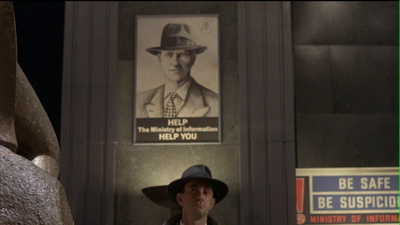
The film was set in 1920s to 1930s props, fashion and buildings , and had many propaganda posters. Baudrillard has some comments related to propaganda:
All through the 19th and 20th centuries political and economic practice merge increasingly into the same type of discourse. Propaganda and advertising fuse in the same marketing and merchandising of objects and ideologies. The convergence of language between the economic and the political is furthermore what marks a society such as ours, where ‘political economy’ is fully realized. It is also by the same token its end, since the two spheres are abolished in an entirely separate reality, or hyperreality, which is that of the media. There, too, there is an elevation of each term to a greater power, that of the third-order simulacra.
(Baudrillard 1983: 125)

Brazil: the propaganda appeared everywhere
Today we can easily encounter huge outdoor advertising. In fact, the propaganda appeared everywhere in the film was a metaphor of today’s huge outdoor advertising. Though the propaganda in the film was often a political statement, it some how foresaw the continued use of image in urban space when entering the technological and information age, to promote any political or consumer message to the public , or even create hyperreality .
Conclusion
Barker notes that ‘the development of electronic technologies that are intrinsic to contemporary cities is bound up with issues of social power and conflict’ (Barker 2003: 370). Brazil showed how people perceived technological and information age in 1980s, in a way different from William Gibson’s works or Bladerunner . Gilliam perceived the technological and information age from the real world at that time, such as the import of Japanese goods, the strong economy of the US and the UK at that time. The challenge of terrorist bombings in the film could summarize what Barker said ‘social power and conflict’ due to the development of technologies. The bombings were as ordinary as having lunch in the film, in which the characters did not have much feeling about them. This was what we face today. The development of technologies not only creates a surveillance society (like the US today), but also labels some people not agreeing with the authority’s or power’s thought oppressive (like the conflict between the US and Islamic world and the problem of terrorism). The film could give us a brief review of why some problems happen in the information age we now encounter.
References
Barker, Chris (2003) Cultural Studies: Theory and Practice , SAGE Publications
Baudrillard, Jean (1983) Simulations , Semiotext(e)
Bell, David (2001) An Introduction to Cybercultures , Routledge
Mosco, Vincent (1988) ‘Introduction: Information in the Pay-per Society’, The Political Economy of Information , edited by Mosco, Vincent and Wasko, Janet, The University of Wisconsin Press
Poster, Mark (1995) The Second Media Age , Polity Press
Robins, Kelvins and Webster, Frank (1988) ‘Cybernetic Capitalism: Information, Technology, Everyday Life’, The Political Economy of Information , edited by Mosco, Vincent and W asko, Jan et, The University of Wisconsin Press
Wikipedia (Brazil) http://en.wikipedia.org/wiki/Brazil_(film)
Wikipedia (Nineteen Eighty-Four) http://en.wikipedia.org/wiki/Nineteen_Eighty-Four