教員室演義現形記
第二回 奸臣語中藏秘訣 法規罅內得逍遙
迷迷糊糊入了一黨之後,雖然對阿姐的照顧期望一一落空,但黨中另一位中堅、坐在我身旁的阿sir大石,在我入職初期實在提供了不少幫助,皆因他將很多學校管理上的漏洞一一說明:
(一)學校的權力都掌握在兩位老闆的手裡,小老闆不甚過問學校事務,大老闆則事事關心,但大老闆為人善忘而三分鐘熱度,所以教師其實只要在九月初做下樣。
(二)教師只要沒有大錯即可留任,學校只要求老師依課程進度而教,功課可俾可不俾,可改可不改,小測可測可不測。
(三)要和某些學生打好關係,因為他們有些會直接走到老闆的面前投訴。
(四)守不守自修室、巡不巡更、搞不搞課外活動都沒有高層會理會,只要paperwork完成了就可以,例如只要在守自修室課節時,點了名便可以回教員室,不用守在自修室內等等。
以上的機宜,令我能以最少的勞力達到學校的要求,即只要paperwork出notes好好睇睇,不必做老闆不知、或不關心的事。我依照這些方法實行了一段時間,輕輕鬆鬆,四點放工。會考課文庖丁之理真可印證於此:
「彼節者有間,而刀刃者無厚;以無厚入有間,恢恢乎其於遊刃必有餘地矣。」
所以眾學子應知中文科課文之道理深廣,他日終有妙用之期。此回已了,一詩記曰:
「朋黨因緣利字先,欲知文化仰前賢。
法規無定王權定,隙裡游行性可全。」
欲知後事如何,請看下回分解。請請。
(傳惑道人 著。
本章回小說純屬虛構,如有雷同實屬巧合,版權所有請勿轉載)
教員室演義現形記
標籤:
教員室演義現形記,
傳惑道人


懷念水
標籤:
天馬行空,
宋以朗,
倉海君

上回飲了K.從捷克帶回來的寶酒,至今身體尚佳。昨晚去了上環吃潮州菜,又機緣巧合地弄出一杯“神水”,似乎冥冥中自有主宰,只好逆來順受。因為這是我們的“集體回憶”,既然無法抵抗酒樓阿姐的“清潔霸權”──大家應該知道,當她出於商業考慮而清理我們杯盤狼藉的飯桌時,其實就是清拆着我們這夜的美好回憶,並掏空了我們一部分的身份內涵──大家只好無奈地拍照留念,以哀悼這餐潮州菜的終結。
我們踏出飯店,儘管依然談笑甚殷,但潛意識中的哀愁畢竟揮之不去。為了在我們的印象模糊之前,盡快在腦海中重建這飯局,為了捍衛我們八人的“集體回憶”,朋友A抖擻精神,強忍睡意,深夜趕緊傳來了這張見證着大家相聚一刻的相片。這杯水,不,這杯後現代神水,有力地象徵了後殖民地的detraditionalization;相信大家都看到,在我們哀悼這餐潮州菜的同時,神水亦情深款款地哀悼着我們八人的身份危機。
今天,我們連一頓飯的記憶也無力保衛,而即使是一個樓面阿姐,我們也無法招架,這些現象背後的權力機制,實在值得大家好好反思。現在謹將拙文獻給昨晚的七位朋友,也希望他們能在照片中獲得一絲慰藉。畢竟,Tomorrow is another day!
22/1/2007補充:
ESWN,A Postmodernist Drink:想知道後現代神水如何誕生,以及那歷史時刻的現場狀況,不妨參考一下宋以朗先生這篇網誌。
評點2007/1/20最緊要{正}字,兼談海外中文
標籤:
正音正字,
mf
今晚的最緊要{正}字,一位教授(記不起名字)居然把「常常」念成「長長」。在國語是對的(cháng),可是查了粵語審音配詞字庫沒有這個讀音,是矯枉過正了嗎?他又把「舌」念成「薛」(sit3),粵語審音配詞字庫判為「異讀字」,何文匯派是念「蝕」(sit6)的。可是他念喜「鵲」又取何派的「卓」不取「雀」,沒有點兒consistency,雖然我也是部分取何派部分從俗。
節目中把「流水淙淙」的「淙」念成「從」(cung4),取了何派的讀音。可是粵語審音配詞字庫也取了「中」(zung4)的異讀,黃志淙就取這個音。DJ蘇施黃原名劉高琮,我不會念琮字。審音字庫判音從,但她本人怎麼念不知。審音字庫果然有用,我曾提出「高麗」怎麼念,審音字庫判讀如字。雖然有人主張粵音當念離,放心了。
不說不知,陳奕迅居然念錯字!節目提到他在歌曲天下無雙中把「難行日子不削我對生命眷戀」的「削」念成「肖」,一直都沒有留意!多年前我在Page One見過陳奕迅,還取得他的簽名。
要是你到過加拿大,你會發現當地的報章甚至電視電台廣播常常出現「A街夾B街」(A街和B街的交界)的說法。在正規的中文甚至現在香港的粵語沒有這樣的說法,是不是「語言活化石」(很多以前的華人到了加拿大保留了當時的說法)?待考。當地的中文把首都渥太華說成「渥京」(雖然「渥」的粵音當地有爭議),城市新西敏(New Westminster)說成「二埠」倒是當地特有用語。美國華埠有很多「孖結」(market),這種說法香港就沒有。他們倒念準了"market"的英語正音"MAR-kit",香港人念成"MAR-ket",有一個漫畫專欄甚至叫「孖屐亭」(Marketing的譯音)。
教員室演義現形記.第一回
標籤:
教員室演義現形記,
傳惑道人
(承蒙眾友厚愛,多番垂詢,欲再覽拙著,見時機合宜,重貼舊作,亦為續作立志之舉矣)
教員室演義現形記.第一回
重回首私校執教鞭 速懊悔蒙童入亂黨
今天回公司(學校)取了最終定案版的離職信,一個學年的私校教學生涯正式結束。是時候回顧一下教員室內外的明爭暗鬥,及所領悟的各項真理。
想當初我一開始踏進公司,原來不知不覺便已被人拉到一黨之中,這黨人由三名青年(二女一男)組成,其中一位是我的科主任(阿姐)。當時的我,固然希望在阿姐的庇蔭和照顧下工作,而且環顧一下教員室其他教師的年紀,這也似乎是我應該加入的黨派了。在頭一天的午飯時,已經聽了大量黨外人士的是非,而是非送飯的情況更無日無之地進行著。
起初我對阿姐恭敬有加,為保持良好關係更出動了小禮物。但我漸漸發覺,阿姐對科務通通無為而治,問她借教材呢,不知放了在那裡;教務安排呢,她挑了容易的便卸下不理。混熟不但沾不到好處,而且她更恃熟賣熟,影印出notes樣樣旨意我之餘,更視之為老奉。我看勢頭不對,當然立即與她保持距離。用了一道不動聲色之策,借口因眼疾而不能直視影印機之閃光,與對面的同事調換了座位,不用再坐在阿姐的旁邊。理云:
「親而不親,明哲保身。」
此乃今後千頭萬緒之首要第一因,今先述之以為引子也。故有詩曰:
「私塾消磨未及年,千絲塵事似雲煙。
看官若要明因果,緣起同儕不並肩。」
欲知後事如何,請看下回分解。請請。
(傳惑道人 著。
本章回小說純屬虛構,如有雷同實屬巧合,版權所有請勿轉載)
二○○六年十二月病史 (上)
標籤:
掬香齋主人
這不是太典型嗎? 當然,我不會去看西醫的,尤其是去看精神科。這不是甚麼諱疾忌醫,而是我一向不太相信精神科藥物會有甚麼好處,不用說不能根治疾病,而且有不小的副作用,又培養患者的賴藥性,勉強只能說控制一下病情,這是我的印象。我這回是用我有限的中醫知識去辨症施治,在中醫來說,這不是神志病,而是虛証。追本朔原,這是由於我長久以來陰虛火旺的結果;陰虛火旺之極,的確會惡化成精神衰弱,幸好我還未至及此。我二千年因腎陰虛服過六味地黃丸、今次因心脾兩虛服歸脾丸,兩種藥的現代用法都可以治精神衰弱。那即是說,倒過來想,凡精神衰弱都可以朝陰虛這個方向想想治法和用藥,不一定要只考慮服用西藥一路。假使一般的精神衰弱患者都是陰虛火旺之極的話,那滋陰就是治法的大經。本來呢,可以睡一覺好的是最重要的,因為我相信睡覺的作用就在於養陰,但是陰虛火旺正正是陰不歛陽,心火上炎而失眠多夢,那又怎可以入睡養陰呢?所以如果給精神衰弱患者一點滋陰的藥,當是很有好處的。希望這點經驗對陰虛火旺乃至精神衰弱的患者有點好處罷。
對於有心跳和不安的驚恐症患者,所服的藥記緊要有重鎮安神之品,例如朱砂安神丸、珍珠母丸等,我服的一種天王補心丹就是缺了朱砂,只可補心陰,而沒有安神的作用,心神不安又怎能安睡呢?切記、切記。
本來在這病的期間想了不少東西,不過真的提不起勁去寫,希望稍候一段時間會好一點,到時再和各位說說。
這是一場不大不小的病。今天是二○○七年一月一日,總算恢復了九成罷。
這病非一朝一夕養成的,這年來我既沒有工作,也不運動;沒有閒錢:很少見朋友,也不出門走動;只呆在家裡讀書。當然,書是讀不成的,精神日漸痿靡,把自己活活的養成一個虛人。
十二月十二日:本來打算去旺角見一份工,是"星際廣場"的一家書店請人。這書店的書固然不吸引我,更甚者是這個商場給我一種局促的感覺,很不舒服,工還沒有見就跑了出來。隨意的在旺角走走,看了幾家書店,時候還早,四處亂走。不知不覺的又走過從前的中學,學校改變了不少,加建了一個不倫不類的僭建,大門口頓覺局促難耐;舊日的大禮堂也給拆了改建,感覺很不舒服。順著常盛街行往土瓜灣,往日的事物變得很不同。天色很灰暗,心情也壞到透。天光道警察宿舍已移為平地。轉向鄧鏡波書院,再轉向新亞中學、協恩書院,這些地方還是頭一回到。在馬頭圍道停了下來,心想:是回家呢?還是再走走?結果還是再走走。往落山道向海邊走去,是我兒時的住處,空氣很混濁,天色又灰暗,心情越發壞。這地方的確髒而亂。天才文具舖和金雀冰室還在,却顯得凋敝。再前行到了旭日街,見到我讀的小學,我就在這個像監獄的地方呆了六年。在景雲街遊樂場望了裡面兩眼,再往海邊行。海水很暗、很髒,但居然有魚,這算直荒謬。穿過海心公園,就是基道中學和顏寶鈴書院,這是從前沒有的。天色開始暗,是時候回家了。穿過啟明街一帶,折回浙江街,又回到了馬頭圍道,突然想去看看兒時常去的郵社,那是在新柳街的;可是走錯了,遇不著。天色已經黑齊,路邊的空氣很混濁,中人欲嘔,人也很倦,就上了一輛二十六號巴士回家了。在聖若瑟安老院下車,轉乘地下鐵。人不很擠,但很悶。當晚沒甚麼,只是心情不很好。
十二月十三日:睡得不算太好,起床之後更不舒服,心跳異常。平日手按著胸,就可以感到的心跳好像沒有了。要用兩手大力按住才覺得有心跳,但這種心跳很促,是滴滴滴滴的急跳。心想是昨天把身子行累了。急喚阿媽煲一大煲圓肉糖水滋陰。我阿媽叫我去應徵超級市場理貨員,以為有工作做有點活動自然會好。我居然同意了,也去了應徵。
十二月十四日:喝了糖水好似沒有效用,心跳仍不正常,睡不安穩。人很不安。
十二月十五日:睡得很壞,家裡有點八珍丸,我想有用罷,陰陽相補。服之,無效。下午有電話來,叫我星期一上班。脾虛,停食圓肉糖水。
十二月十六日、十七日:抑鬱愈來愈嚴重。仍服八珍丸,無效。睡得很壞,心跳仍不正常。
十二月十八日至二十二日:除了星期四二十一日那天是假期之外,其餘也上班,真的很累。上班是為了逃避抑鬱,說有效也可以,但大體上作用不大。睡得果然好了一點,不過只是由於體力透支。這幾天仍服八珍丸。二十二日下午,當我洗貨架的膠間格時,就在我不遠有一個賣金莎朱古力的小攤,一個四十多歲的女人做推廣員,這是一種不太辛苦的工,我心想:這份工的確太累人,我應該找一份比較適合的工作去做,其他的人做我的工作可以是做得很開朗而愉快的,我又為什麼佔了這一席之位呢?於是決定了辭職。一想到辭職,心情有了半刻的輕鬆,但總體上仍然抑鬱。
十二月二十三日:在家休息。沒太大的好轉。不過自己推斷是心脾兩虛。去了藥房買了歸脾丸。食了果然好了點。
十二月二十四日:自度好了六、七成,會倉海君,希望說說閑話可以舒緩抑鬱。十二時左右到了大埔,邊行邊說,一時多吃午餐,其實這多天以來是全無胃口的,飯是勉強吃下,腰圍已經瘦了兩寸。三時左右會張生。有兩、三次精神很困倦,要打斷對話休息。五時多就回家了,不敢過用心神。回家之後有一段時間很平靜,但惡夢方才開始:我大約九時就寢,直至七時多天亮了仍不能入睡,在床上只是合上雙眼,前額漲痛;後來稍稍淺睡了一會,方才好了一丁點。這簡直是重複了十二日的事。
十二月二十五日:這是我最憂心的聖誕節。下午勉強吃了點東西又再去睡,睡不著。翻書看看有沒有辦法解決。翻出了一條張仲景的酸棗仁湯,治"虛勞虛煩不得眠",急急去藥房要了一劑。由於飲了藥,加之二十四日晚徹夜不眠,二十五日晚總算睡得好一點。同日又轉了吃天王補心丹。
十二月二十六日:聽我媽的叮囑,再服了一劑酸棗仁湯。
十二月二十七日至二十九日:始終睡得不好,每天四、五點鐘就醒了,再難入睡,很易驚醒。反來覆去很難才到七時多天光。胃口好了些少。
十二月三十日:所服天王補心丹成藥因為獨缺朱砂一味,所以只可以滋心陰,却少了重鎮安神的功效。今天選了朱砂安神湯。 這湯有大黃,喝的時候不覺很苦,可喝了之後牙齒全是苦的,刷了牙也無濟於事,好奇怪的感覺。
十二月三十一日:雖然仍是早醒,但心沒有那麼不安。這幾天抑鬱間中來襲,也沒法子。
一月一日:今天好了很多,心也踏實不少。
這場病大約就是如此,由於只是事後的追記,也只可能盡量的準確。本來一場病沒有甚麼必要大費周章的做文章紀念。可是,這是一場不普通的病,是我一生中的一個不尋常的難關,這是餘話,容後再談。
巧合的是:一月五日讀報得知這病西醫叫做"驚恐症"(panic disorder),乃情緒病的一種。患者會突然感到強烈驚慌,徵狀包括心跳突然加速、胸口不舒服、呼吸困難、作悶作嘔、冒冷汗、怕患上精神病、有麻痺或針刺的感覺、驚自己會暈倒、驚自己會死、驚控制不到自己。如果在過去一個月內,同時有上列三項病徵,有可能患上驚恐症,患者的生活會大受影響。據香港中文大學醫學院香港情緒健康中心於二○○二年的電話訪問,3004個受訪者中有3.9%有驚恐症;一半的驚恐症患者會演變成抑鬱;45%受訪患者曾經有自殺念頭。(資料來源:中文大學醫學院香港情緒健康中心主管李誠醫生;可參考明報的報導http://www.mingpaohealth.com/cfm/news3.cfm?File=20070105/news/gmk1.txt)
我是犯這種病了,諸種病徵中我有:
一、心跳突然加速
二、胸口不舒服
三、作悶
四、怕患上精神病
五、有麻痺的感覺
六、驚自己會暈倒
七、驚自己會死
八、驚控制不到自己
這不是太典型嗎? 當然,我不會去看西醫的,尤其是去看精神科。這不是甚麼諱疾忌醫,而是我一向不太相信精神科藥物會有甚麼好處,不用說不能根治疾病,而且有不小的副作用,又培養患者的賴藥性,勉強只能說控制一下病情,這是我的印象。我這回是用我有限的中醫知識去辨症施治,在中醫來說,這不是神志病,而是虛証。追本朔原,這是由於我長久以來陰虛火旺的結果;陰虛火旺之極,的確會惡化成精神衰弱,幸好我還未至及此。我二千年因腎陰虛服過六味地黃丸、今次因心脾兩虛服歸脾丸,兩種藥的現代用法都可以治精神衰弱。那即是說,倒過來想,凡精神衰弱都可以朝陰虛這個方向想想治法和用藥,不一定要只考慮服用西藥一路。假使一般的精神衰弱患者都是陰虛火旺之極的話,那滋陰就是治法的大經。本來呢,可以睡一覺好的是最重要的,因為我相信睡覺的作用就在於養陰,但是陰虛火旺正正是陰不歛陽,心火上炎而失眠多夢,那又怎可以入睡養陰呢?所以如果給精神衰弱患者一點滋陰的藥,當是很有好處的。希望這點經驗對陰虛火旺乃至精神衰弱的患者有點好處罷。
對於有心跳和不安的驚恐症患者,所服的藥記緊要有重鎮安神之品,例如朱砂安神丸、珍珠母丸等,我服的一種天王補心丹就是缺了朱砂,只可補心陰,而沒有安神的作用,心神不安又怎能安睡呢?切記、切記。
本來在這病的期間想了不少東西,不過真的提不起勁去寫,希望稍候一段時間會好一點,到時再和各位說說。
集體回憶
標籤:
明日黃花,
華利
集體回憶好像針藥,近來不斷注射進我的眼、耳、口、皮膚。每當這 4 個字由新聞報道員的口裏飄進我的耳裏,或在紙上電腦螢幕上靜默地讀着,皮膚的毛管便不由自主豎得直直的。我不知道為什麼,只不過覺得,這個詞聽來有點別 扭,真的,本身這 4 個字讓我聯想到,這個城市那種懶得思考,「人講你又講」所產生的跟風做作。若果真的要說這 4 個字使我想到什麼,立即就想起大陸改革開放前的「集體什麼」...「集體生產」、「集體早操」、「集體上廁」... 這些鼓吹人民大團結的概念和宣傳口號。不過抵着豎毛管的難受再去想清楚,集體回憶便是有一班人有共同的過去,於是好像中小學班裏同學開茶會去旅行,留下美 好回憶。可是又因為「集體」這個 prefix,我又想到,中小學這些活動,如果你不參加,不合群,就會被人說你「摺」,甚至不是一個好學生,因為好學生除了要「學習為了求分數」,也要積 極參與集體課外活動。
這 4 個字會加入評估古跡文物的準則裏。如果成事,我想我會申請保留沙田某間哈迪斯為受保護文物。十多年前,家教深嚴得簡直妨礙我學會基本的社交技能。一個十 五、六歲的中學生仍不可以跟朋友出外玩。於是我挾着什麼要集體做功課等不可不出外的藉口,成功溜出去跟同學到沙田踩單車。踩了半天便到那時剛開的哈迪斯歇 腳。因為難得出外,印象特別深刻,成了我的美好回憶,還有同行的人的美好回憶,店裏不相識的顧客也該感受到的我的美好回憶,集體回憶 ...
Somewhere in the 20th Century - 'Brazil', a 1980s View on the Technological and Information Age
標籤:
華利,
戲如人生
In early 1980s, computers were still regarded as large machines processing electronic data. The ‘electronic data processing’ was a popular term, which reflected how people perceived computers at that time. In 1984, Macintosh computer was introduced, and marked the breakthrough of personal computer technology. It promoted the idea of ‘user-friendly’, by virtue of graphical user interface, eradicating entering complicated text commands to make computer do things. The model, concept and the habit of using a personal computer today, such as operating through GUI with a mouse in addition to a keyboard, was originated from the standard of this first Macintosh computer introduced. The easiness of operating a computer helped to speed up the development of the technological and information age in the coming 20 years. Today the term ‘electronic data processing’ is rarely used, and is replaced by ‘information technology’, to reflect the change in the concept of how computers are used - they are small, or even portable, and become vital tools for our work, study and even daily life. Not only we can process data, but also search and present information, and refine information to our knowledge with computers. The data or information do not confine to text, and also multi-media. We can get entertainment from computers, which poses a threat to traditional media business, such as TV, radio, and music and film industry. The early 1980s, therefore, marked a historial moment of the technological and information age we now experience.
People at that time could foresee that the coming of technological and information age, which was pushed by the technological revolution of personal computer. At the same time they seemed having much doubts and fears about how the society would change. Such doubts and fears were represented by some science fiction films, such as Bladerunner , which illustrated a ‘high tech’ but ‘low life’ city. Even entering the early 1990s, the making of the animation series Wallace and Gromit still shared similar concerns, such as the reliability and the misuse of technologies, which could in turn become crisis for human beings.
In this article, I’d like to study how people in the early 1980s perceived the technological and information age coming, in a sense of fear and crisis, from the analysis of a science fiction film, Brazil , released in 1985. After 20 years, when seeing the film today , people may find Brazil some how predicted some changes which really happen now. It would be interesting to see why people at that time could think of the changes happened today, and also the changes they guessed wrong or missed.
Background and synopsis of Brazil
Brazil was filmed by Terry Gilliam, and its screenplay was written by him, Tom Stoppard and Charles McKeown. There were 3 versions during the theatrical release of the film. The version to which I refer in this article is the 142-minute director’s cut. It is the version which followed the author’s original idea of making this film.
A s what the caption said ‘somewhere in the 20th century’ in the opening of the film , Brazil was set in sometime of 20th century, and the location seemed to be a high-tech or ‘cyberpunk’ city, with information easily accessible, and fully electronic automation of home and office. The main character Sam Lowry, worked in the Ministry of Information (MOI), met his dream girl Jill Layton when she reported a mistaken arrest of her neighbour as a terrorist by MOI. Jill was pursued and in danger since the authority wanted to hide the mistake made. Sam tried to rescue her but failed, and was finally underwent ‘frontal lobotomy’ by the authority.
Information and power
Gilliam revealed that the film was inspired by George Owell’s 1984 , and the working title of the film was 1984 1 / 2 . Owell’s 1984 was a novel, published in 1949, of 3-part story: ‘The first part deals with the world of Nineteen Eighty-Four as seen through the eyes of Winston; the second part deals with Winston's forbidden sexual relationship with Julia and his eagerness to rebel against the Party; and the third part deals with Winston's capture and torture by the Party’ (Wikipedia: Nineteen Eighty-Four). The structure and the story of Brazil are much alike those of 1984 , as what Gilliam said, ‘written from today’s perspective’ (Wikipedia: Brazil).
Gilliam replaced the ‘Party’ of 1984 with ‘Ministry of Information’ in Brazil . We can see that people often relate ‘power’ with ‘who control the information’ in the information age or cyberspace. Barker cites Touraine that ‘the dominant class is that group able to access and control information’, and we will have ‘technocrats and bureaucrats counterpoised to workers, students and consumers’ (Barker 2003: 162). In the film, the head of MOI was the Deputy Minister named Helpmann. MOI was a large bureaucratic itself, had its security team and weapons, and c ould interrogate any suspects without any formal reason and explanation.
The relation among several characters in the film showed such ‘power-information’ connection. Sam’s first boss Kurtzmann trusted and depended on Sam very much, since Sam knew how to use computer to solve various problems for him. Sam was the son of a late senior information official, who was the Deputy Minister Helpmann’s good friend. Sam’s mother, despite she did not work in MOI, could request getting Sam promoted as she liked. Sam’s relatives and friends often told Sam going to see a doctor since he rejected the promotion. Sam’s mother got respected everywhere while Sam, since he was not promoted and not well known, was often rudely inspected in restaurant and party, until her mother told them he was her son.
We can see from the film that, after entering the technological information age, the authority and corporation were ‘centralized’, e.g. Central Services, Central Computer, Central Banking. As Mosco suggests, ‘power sets the pattern for the principal direction of production, distribution, and use [of technology]’ (Mosco 1988). Why the author of the film suggested a ‘centralized’ structure for the authority and the corporation in the information age, is that it facilitated the collection of capital and the surveillance.
But from today’s development of information technology, we can see a very different picture of social structure: a community-based relationship exists in the cyberspace without central control . People can do anything they like once they connect to the Internet, without much worries of the interference from the authority. Even some governments exercise content filtering, people can still find ways to pass through the roadblock. Gilliam and others in 1980s might overlook the technology of network, or later, the Internet, which was not known by ordinary people at that time.
Bell cites Porter that ‘the aim of current systems of power is to make people accessible to computers (rather than vice versa), since computers are “perfect” disciplinary (and disciplined) machines’ (Bell 2001: 84). Therefore ‘computers do the work of supervision (or surveillance) ... also produce three other effects of discipline ...’ (Bell 2001: 85).
A surveillance society
The city presented in the film showed us how people thought a surveillance society would look like in the coming technological and information age, or, in the urban space built up from cyberspace. Apart from the robots with cameras, connected to a CCTV system, monitoring peo ple, the author imagined that the ducts (or, wires and cables) were everywhere, penetrated deeply through the physical infrastructure, home and the office. At the beginning of the film, commercials were showed to emphasize the importance of the ducts in daily life. The information, in the form of papers and documents, were transferred through the ducts, without the need of human interference. Another use of ducts was for air-conditioning, and also other automatic devices installed at home and in the office. It was illegal for people to reapir those ducts or the devices without the permission of Central Services, a market-dominated corporation, which might be related to the authority. Another character Harry Buttle was regarded as terrorist, since he provided service repairing those devices himself. Audience could see ducts everywhere in the film, being an outstanding symbol for the devices and tools facilitating authoritarian surveillance.
People often thought that technological and information age assumed a highly surveillance society coming , even in the ‘Western’ capitalist world in 1980s. Robins and Webster believe that, by citing Focault’s concept of panopticon - ‘a machine that ensures the infinitesimal distribution of power, one that turns the monitored individual into a visible, knowable, and vulnerable object ’ - ‘on the basis of “information revolution”, ... the social totality ... comes to function as the hierarchical and disciplinary [p]anoptic machine’, and so ‘we can see that a technological system is being constituted to ensure the centralized, and furtive, inspection, observation, surveillance, and documentation of activities on the circumference of society as a whole’ ( Robins and Webster 1988). Apart from the ducts mentioned before, there was a dialogue repeated several times, ‘you can’t move without a form’. People in the city presented by the film had to fill in different types of paper forms in order to do almost anything, for t he authority could control people’s daily life as far as possible . Volumes of paper forms were then processed by computers, with the help of large number of people working in different departments of MOI. At the beginning of the film, a moving shot showed the MOI department for which Sam worked, which was a gigantic office, messed around by countless staff. The complicated form-filling surveillance, also contributed to the formation of the bureaucratic, the MOI, in the story. Such form-filling surveillance also had the panopticon effect, expressed by an exaggerated humorous scene, in which after Sam asked the 2 Central Services technicians whether they filled the forms required or not, the technicians were in panic reflexively since they did not. In fact, almost any character was highly alert when he or she did not want others know what they did. For instance, Sam’s first boss Kurztmann had to make sure nobody tapping in his own office, even there seemed no tapping he still dared not talk very loud with Sam about his troubles.
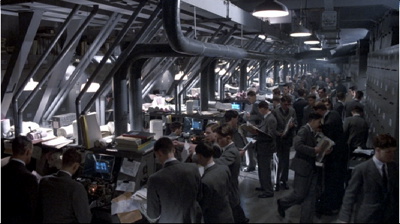
Brazil: a gigantic office, messed around by countless staff
In mid-1980s, the development of Structured Query Language (SQL), the syntax widely used to manipulate database today, became standardized and improved. Today’s use of SQL in almost any database application was based on the version released in 1992. 1980s was the period when the effectiveness of database quickly improved. People at that time could already conclude that we would live together with database in the coming years. Poster claims database as a ‘super-panopticon’, which ‘[i]n its electronic and digital form, the database is perfectly transferable in space, indefinitely preservable in time; it may last forever everywhere’, and ‘is no one’s and everyone’s yet it “belongs” to someone, to the social institution that “owns” it as property ...’. So ‘[t]he database is a discourse of pure writing that directly amplifies the power of its owner/user’ (Poster 1995: 85). It ‘transform[s] our acts into an extensive discourse of surveillance, our private behaviours into public announcements, our individual deeds into collective language’ (Poster 1995: 87). Database was not explicitly specified in the film, and was an invisible but the most valuable facility. The department processing database information had more power than the one entering data. With the information retrieved in the database, people could be interrogated without knowing being pursued and their actions recorded. For instance, Jill was quickly known for its witness of mistaken arrest by various characters after accessing the central database record.
A consumer society
In a scene there was a boy answering Santa Claus that he wanted a credit card as his Christmas gift. Gilliam predicted our capitalist way of life would perpetuate in the technological and information age. Robins and Webster claim, with Garnham’s perspective of political economy, that ‘[t]he function of new technologies “to develop the market for so-called information goods and services as a new growth sector” that expresses both “the needs of the corporate sector for enhanced communications facilities and the increasingly desperate national search for a share of the international market in high technology products.”’ (Robins and Webster 1988). P eople in 1980s, in fact, already kn e w the economic value of information, such as financial data. W hen the society enters information age, in which having information means having more profit or even power, a ‘pay-per society’ stated by Mosco (1988) will emerge. Mosco suggests that ‘new technology makes it possible to measure and monitor more and more of our electronic communication and information activities ... business and government see this potential as a major instrument to increase profit and control’, which results in ‘pay-per society’ (Mosco 1988) . Such observation could be reflected by the beginning of the film, in which, as the authority dominated the information collection and retrieval, Helpmann was interviewed and talked about ‘information retrieval charge’. Every time if MOI was involved in handling application or operation, the people had to be charged. When Sam was interrogated after he tried to rescue Jill but failed, not only the officials asked him many questions, also the legal and insurance counterparts promote their services which could suit Sam’s need. It was possible since those counterparts could get relavent information from MOI easily and quickly .
The surveillance stated before not only helped monitoring public activities, as showed in the film, also acted as a way to promote physical goods and products. TV still appeared everywhere in the film, not only the programmes but also the commercials, for example, the ‘ducts’ commercial at the beginning of the film. Office staff could peep TV programmes at work like us today. Robins and Webster seek the example of cable television networks, which ‘can continuously monitor consumer preferences for programming material, along with the details of any financial or communicative transactions’ (Robins and Webster 1988). It was interesting to note that, the staff peeping TV programmes at work in the film, was similar to what we do today, such as surfing the WWW during work. But we cannot say Gilliam predicted it, as it was believed that he only wanted to show the effect of TV in the information age, since he, as I said before, like other people at that time, did not know that the network and the Internet technology will soon became mundane.
Such ‘consumer-information’ connection was not only reflected by the authority controlling information, also reflected by the domination of service provider, or the ‘centralized’ concept. People could only rely on the services and products, such as ducts, provided from Central Services. The wife of the mistaken terrorist could not get refund since she did not have an account in Central Banking. People had to rely on the Central Computer from MOI to buy things and do transactions. A character had said that everyone could not live without the Central Computer.
Technology determined subjectivity and identity
Sam got promoted and went to work on the first day. He asked the reception whether he was required to present his ID or be inspected. The reception answered him that ‘you can’t be anybody’, and so there was no need for him to prove who he was by himself. In the information age, as presented in the film, everybody has his or her identity determined by the information recorded in the database. You are in fact a number to the authority, not anyone or not even you. From the view of Foucault, a subject is ‘the product of power which individualizes those subject to it’ (Barker 2003: 229). With new technology, the authority wanted to control everybody, who could be anyone as the authority requested. The story of the film was developed from the mistaken arrest of Buttle, as a terrorist, who should be Tuttle. After Sam got promoted, he was assigned another number. The security team of MOI only recognized him with his number and his MOI badge. The team had to follow strictly the instructions of the MOI officials, no matter who the official was. Mosko states, according to Foucault, that ‘[t]he individual becomes the ob ject of surveillance, no longer the subject of communication’ (Mosko 1988). Sam could ‘kill’ Jill by deleting her record in MOI computer. This reflected what Foucault notes, ‘a system of individualizing and permanent documentation: the observed and scrutinized individual, subjected to continuous registration, becomes object of knowledge (of files and records)’ (Mosko 1988). Ultimately, the film presented the worries, through the ‘centralized’ concept, about ‘increasing centralized state and police surveillance/intelligence activities’ (Mosko 1988).
Foucault suggests that ‘discourse (as regulated ways of speaking/practice) enables speaking persons to come into existence’, which is done by ‘offering us subject positions from which to make sense of the world while “subjecting” speakers to discourse’ (Barker 2003: 229). The discourse here could be ‘database’ in the film. In fact, various views on subjectivity and identity of the film stated could be again accounted to the ‘super-panopticon’ suggested by Poster :
If we looked at databases as an example of Foucault’s notion of discourse we see them as “exteriorities” not as constituted by agents, and we look for their “rules of formation” as the key to the way they constitute individuals. Databases in this sense are carefully arranged lists, digitalized to take advantage of the electronic speed of computers.
(Poster 1995: 87)
Then he points out how different such super-panopticon forms subject from what Foucault suggests:
Foucault argued that the subjects constituted by the panopticon were the modern, “interiorized” individual, the one who was conscious of his or her own self-determination. The process of subject constitution was one of “subjectification”, of producing individuals with a (false) sense of their own interiority. With the super-panopticon, on the contrary, subject constitution takes an opposing course of “objectification”, of producing individuals with dispersed identities, identities of which the individuals might not even be aware.
(Poster 1995: 93)
Buttle would not know he became a terrorist, until somebody was arrested by mistake. In the end, since Sam objected the MOI, and tried to deviate from the thought of the authority, he was regarded as guilty and mad, and had to undergo ‘ frontal lobotomy’ - even his dreams were controlled and invaded by the authority with technology to make him not to be oppressive - he was really controlled and ‘identified’ by the authority with technology.
Technophobe and urban space
Gilliam was pessimistic about the changes in the technological and information age, or a ‘technophobic’. We could see from the film that many problems and troubles happend because technology was not reliable. Butte was mistaken as terrorist because the machine which printed the report was malfunctioned. Sam woke up late because his clock did not run, so the automated devices at home were not operated to wake him up. Later his air-conditioner was out of order, and he could not sleep like normal (will we now cannot sleep if the air-conditioner broke up). Gilliam wanted to present that those ‘technophobic’ problems were , in fact, caused by humans. People should make those technological products more reliable, or at least would not cease people’s everyday life even the products broke up. The repair service provided by Central Services was very poor. Sam called them about the malfunctioning of his air-conditioner, but he only got the answer which said that it was not service hour and could not help him. The technicians could not give help due to the bureaucracy and the complicated form-filling procedures. No matter how the technology evolves, Gilliam wanted to tell the audience that technology might not make our life better, as the key factor is still humans. How they design the technology, how they use the technology. Though Gilliam was ‘technophobic’, he did not interpret ‘technophobic’ simply by ‘technological determinism’. In 1980s, corporations continued to grow by merge and acquisition, and people could see the domination of market, especially the technology products and services, from those large corporations. So Gilliam would imagine a dominated service provider Central Services, and had some relationship with the authority. It was the domination or ‘centralized concept’ eventually contributed to people’s ‘technophobic’ thought.
In the film there were many scenes about Sam’s dreams. One of his dreams was that he fought with a Japanese samurai. This could be another sign of Gilliam’s, or the Western world’s technophobe in 1980s. Many film critics claimed that the metaphor of this scene was the Western world’s fear of the import of Japanese electronic goods and technological products. In 1980s, Japan became one of the main designers, researchers and manufacturers of those electronic and technological products in the world. Their products were cheaper but high quality, and could compete with those made by the US and Europe. Why Gilliam represented technophobe by a samurai was because of the worries about the fear of the domination of Japanese technological products in the Western world.
The urban space illustrated in this film was not alike what the William Gibson’s work or Bladerunner presented, which was called a ‘cyberpunk’, a ‘high tech’ and ‘low life’ city. Some places in the city in the film were neat and clean. Especially the high and grand buildings, because Gilliam thought of information age from the 1980s situation, represented the authority, and made the audience think of Fritz Lang’s Metropolis , a 1920s film illustrating a future urban space. There were still places that were old and dirty, with poor people living, but unlike the ‘film noir’ tone presented in Bladerunner or other ‘cyberpunk’ works.
The film was set in 1920s to 1930s props, fashion and buildings , and had many propaganda posters. Baudrillard has some comments related to propaganda:
All through the 19th and 20th centuries political and economic practice merge increasingly into the same type of discourse. Propaganda and advertising fuse in the same marketing and merchandising of objects and ideologies. The convergence of language between the economic and the political is furthermore what marks a society such as ours, where ‘political economy’ is fully realized. It is also by the same token its end, since the two spheres are abolished in an entirely separate reality, or hyperreality, which is that of the media. There, too, there is an elevation of each term to a greater power, that of the third-order simulacra.
(Baudrillard 1983: 125)
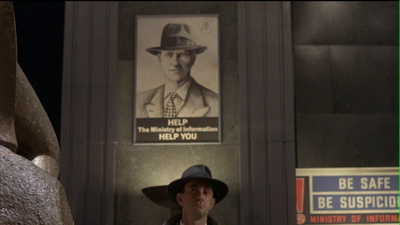
Brazil: the propaganda appeared everywhere
Today we can easily encounter huge outdoor advertising. In fact, the propaganda appeared everywhere in the film was a metaphor of today’s huge outdoor advertising. Though the propaganda in the film was often a political statement, it some how foresaw the continued use of image in urban space when entering the technological and information age, to promote any political or consumer message to the public , or even create hyperreality .
Conclusion
Barker notes that ‘the development of electronic technologies that are intrinsic to contemporary cities is bound up with issues of social power and conflict’ (Barker 2003: 370). Brazil showed how people perceived technological and information age in 1980s, in a way different from William Gibson’s works or Bladerunner . Gilliam perceived the technological and information age from the real world at that time, such as the import of Japanese goods, the strong economy of the US and the UK at that time. The challenge of terrorist bombings in the film could summarize what Barker said ‘social power and conflict’ due to the development of technologies. The bombings were as ordinary as having lunch in the film, in which the characters did not have much feeling about them. This was what we face today. The development of technologies not only creates a surveillance society (like the US today), but also labels some people not agreeing with the authority’s or power’s thought oppressive (like the conflict between the US and Islamic world and the problem of terrorism). The film could give us a brief review of why some problems happen in the information age we now encounter.
References
Barker, Chris (2003) Cultural Studies: Theory and Practice , SAGE Publications
Baudrillard, Jean (1983) Simulations , Semiotext(e)
Bell, David (2001) An Introduction to Cybercultures , Routledge
Mosco, Vincent (1988) ‘Introduction: Information in the Pay-per Society’, The Political Economy of Information , edited by Mosco, Vincent and Wasko, Janet, The University of Wisconsin Press
Poster, Mark (1995) The Second Media Age , Polity Press
Robins, Kelvins and Webster, Frank (1988) ‘Cybernetic Capitalism: Information, Technology, Everyday Life’, The Political Economy of Information , edited by Mosco, Vincent and W asko, Jan et, The University of Wisconsin Press
Wikipedia (Brazil) http://en.wikipedia.org/wiki/Brazil_(film)
Wikipedia (Nineteen Eighty-Four) http://en.wikipedia.org/wiki/Nineteen_Eighty-Four
工資﹑貧富﹑新移民
標籤:
明日黃花,
道士
應邀複製﹐一想也好﹐正和左兄no equality 呼應一下﹐不過不只在法律前﹐人生就是不平等。
我相信社會不是公平和不是公正的﹐因為天然資源的分配﹐就從來不是均衡地散佈﹐每人的資質也會不同﹐正所謂十隻手指有長短﹐想把一切公平瓜分的社會概念﹐根本就不乎合實際和天然原則的﹐自然無可能辦到。在現代社會﹐人要盡量去執行公平公正的理念﹐雖說法律面前人人平等﹐不過哄動一時的藝人調包案﹐又或如當年美國的訴訟經年的OJ事件﹐也清楚反影出社會從來就不是公平的﹐公平 - 就是種推廣出來的假像﹐錯誤的社會共識。就算同樣刑罰﹐例如說違例泊車的數百元﹐對一個趕住送貨的貨車仔﹐和一個駕波子貪方便的司機﹐也永遠不會有同等的相對價值。今次想寫的不是社會的道德標準﹐而是說說最近常在新聞見人掛在口邊的最低公資和貧富懸殊。
既認為天下不公﹐我很自然不讚成立例去提高最低公資。先不要談經濟上加重中小企的負擔﹐也不要說拉上補下這基本法則﹐就說在我眼中見過的某些人﹐莫說最低公資已經給多了﹐根本要稱為人也該受到質疑﹐到底社會是否有責任去負荷自己產生出來的廢人﹐甚至去負擔外地輸入的失業包袱。我先給些實例﹐說實我回港後也因此例子而大開眼界﹐才明白了香港為何都會有人失業(這些人也應該失業):我曾見過廚房兩個做打雜的男孩﹐主要便是在下午幫幫我手﹐執頭執尾﹐也不是對工作能力有什麼奢求。一個做了一天﹐一個做了兩天。做了一天那個呢﹐就是懶﹐莫說複雜的事不懂﹐我已叫他只要洗碗﹐當然要知如何洗得最好是有當中學問﹐不過結果我正在炒午市也要落手洗埋碟﹐連洗碗這種手板眼見的功夫也做不來。好﹐且說他未嘗過﹐我也由他﹐催促兩聲便要回到自己崗位。跟著我看見那幕更奇﹐居然洗好的酒杯﹐他不用平的盤子放﹐卻找個廚房用的圓盤玩杯子疊羅漢﹐如此無common sense﹐已經無名火起﹐不過我還在忍﹐又示範了一次我認為該是基本常識的事。幾小時後﹐吃晚飯時我又見到他門齒居然在中間穿了個黑洞﹐其實已經反感到覺得難以忍受﹐連來自第三世界的緬甸洗碗婆(夜更)也講了句:「有無韮菜呀?」本來想有人總好過無人﹐準備叫他多試一天。他居然還夠膽說明朝十點自己唔得閒﹐要遲多兩個鐘﹐係唔係這種人也要提高工資? 當然計了那天人工便請佢好行。做了兩天那個﹐其實也沒什麼﹐也就平凡一點﹐就是實在蠢得要緊﹐說了十幾次的事還是可以不記得﹐就像隻壞錶一樣分分校﹐秒秒撥﹐叫他做事倒不及自己做好﹐實在是沒精神﹑時間和資源去從新培育他的一切。又有個在加拿大的例子﹐自家曾開過間小店﹐其中曾聘請過個自中國內地的加拿大新移民﹐不想太仔細去談這個女人了﹐我只想節錄幾句她的偉論:「要把紙皮箱割開拿去丟掉? 這種事我不懂幹。」「唉! 還是在國內的工作好﹐我以前每天也只是喝喝茶﹐看看新聞紙就算一天了。」「要洗頭? 我一向也習慣了一個月洗兩次﹐你們香港人還真是麻煩!」世間就是有這麼的一群人。
再要說說我前幾個星期在地鐵內聽都的一段對話。 是五個師奶﹐和一個男仔﹐他們一群剛下班﹐正在閒聊﹐其中那男孩說:「我現在住的地方真差!」其中一個身形較橫的山東婆操著流順帶鄉音的廣東話大聲教說著﹐我把她的言論概括如下:「你呀!社署梗係唔排你地換樓啦﹐你地申請個陣梗係要有幾慘講記慘﹐咁先批得快加嘛。我呀!有個同鄉呀﹐三個幾月就批咗啦。你要同社署D人講﹐宜家每日都有好大壓力﹐話你甚至想斬人咁﹐有幾嚴重就講到幾嚴重﹔如果人地問到點解以前無問題﹐就話家人磨擦越來越多﹐再唔搬呢就唔知幾時可能真係會搞出人命。我同鄉呀﹐宜家批個度成三個房﹐你唔講得嚴重D 呀﹐人地點會理你﹐可能等幾年都未批比你呀。」大街大巷﹐她也見到我在聽﹐不過憑她帶點微笑的眼神﹐知她公然認為欺騙政府的智慧是益了我。
現在酒店內也會請些弱能人仕去做內部清潔(這些人比上面所提起的廢人還可做得更多更好!)﹐因為大概既可當公關手段﹐又可節省開支﹐人工雖收六七千﹐其實一半以上就由這些所謂督導的團體入袋﹐(善事無收入﹐便無這麼多慈善機構﹐我雖不是說世間全無有心人﹐但畢竟有心人還是需要開飯的。我所見的那個督導員﹐我就覺得其為人極有問題。)(我曾經和個做過撒瑪利亞會義工的人談過話﹐她也說﹐聽過這麼多不幸的電話﹐其實連自己的內心也會消沉的。) 那些弱智人仕實收約二千七﹑八﹐也是小於十數元一小時﹐就算工作得比別人更勤力﹐他們的回報就是會比人少。自己看到那個十來二十歲的少年在一角傻笑﹐心內有過一剎那的酸﹐不過卻明白不公平是不只是在社會上﹐而是種沒有任何人可改變的自然界定律。法律上可管制的就只有商業機構因壟斷帶來的收益﹐香港時至今時今日﹐連對普遍的市民general public 仍然未能做得到較全面的保障﹐還拉扯什麼最低工資?
自古以來﹐社會就會受到各方面的蠶蝕﹐是種不能根絕的禍患。現在居然有垃圾政黨用個貧富懸殊差距增廓的籍口而提出要求提高最低公資來減少人民生活距離。試想想﹐每日也放百幾人來港﹐這些新移民很多自然在物資短缺的情況下來港的(精英制吸引人材/投資家卻是好的)﹐無論香港人普遍民生好壞﹐這些新移民相對下也會是生活質素欠佳﹐難道要每人入境就派番十多二十萬去拉近這調查數字上的差距嗎? 順帶想到人口老化﹐很多歐洲國家也會面臨人口老化﹐例如瑞典等地﹐有政府貼奶粉貼錢貼教育都無人想生﹐因為普遍教育程度高﹐生活水平也高﹐孩子也會受到大眾愛戴的喜悅﹐經計劃才生出來﹐甚至教人想起﹐「幼吾幼以及人之幼」這句說話。我一向也認為要世界的人口能做到有自制﹐才會有什麼完美社會/主義出現的可能性﹐不過我也膽敢說﹐不單遙遙無期﹐而且依據人的本性﹐這種理想根本就是天荒夜談﹐還是待第三次世界大戰的可能性較高。(要戰爭﹐實在比要改善社會的工程簡便得多了﹐多一兩個布殊就成。) 香港卻又不知為何會訂立生夠四個就有樓上﹐又有公援這些政策﹐教育卻越搞越糟﹐出產的人口也自然越來越垃圾。再加上來港產子那批人﹐其實香港政府不如先憂愁新移民將來會造成的滿民皆廢之患﹐這種發展方向只會為社會帶來更長遠的禍害。無論治安﹑公民意識各方面﹐我也只見到個下坡。
An Ancient Practice in the Modern World
標籤:
左冷禪,
法律隨筆
Earlier there has been a question posted in this blog (in fact it was a response to my Chinese essay), querying how on earth the practice of male succession right in the New Territories still exists and is so inconsistent with our 21st century modern Hong Kong . Although I am not an expert in this area of law, nor was I given any opportunity to explore it during my study of law degree, I am more than happy to share my limited knowledge to this branch of law with you all blog viewers.
Before discussing land succession in New Territories, perhaps we should first examine the land ownership system in Hong Kong. Theoretically in Hong Kong, there is no private land ownership, or alternatively known as fee simple land in legal context. All land before the handover belonged to the British Crown, and now after 1997, being the property of the PRC government. Thus land in Hong Kong, except the St John Cathedral, is leased out by the government under a lease term or condition of grant, and the said lease nowadays usually lasts until 2047. And under this system, government rent (previously known as crown rent) is payable by all landowners / lessees in Hong Kong. But as the land in the New Territories was not ceded to the British in 1898 as Hong Kong Island in 1842 and Kowloon Peninsula in 1860, and in order to pacify the natives who were once very against the British exercise of sovereignty on their soil, the Colonial government allowed the natives, otherwise known as indigenous inhabitants (原居村民), to retain their land ownership. In fact, in the early 20th century (1908 I guess), the Colonial government hired a group of Indians to conduct a large-scale investigation on New Territories land and eventually they drew up an official land ownership record called the Block Crown Lease, which recorded all the land partitions and owners’ details. The Block Crown Lease as a title document in proving land ownership in New Territories does not pale into insignificance after the handover.
The Small House Policy (丁屋政策), or the exclusive right of indigenous male inhabitant to build a 3-storeyed house on a designated piece of land, has its legal basis under section.7 of the New Territories Ordinance (新界條例)Cap.97 and section.5 of the New Territories Land (Exemption) Ordinance (新界土地(豁免)條例)Cap.452. Under the present system, any male of 18 with paternal ancestry in an established village in the New Territories since 1898, is regarded as indigenous inhabitant. Once coming to full age, they could then bring their applications for the erection of small houses to the District Lands Office (it is a very complicated matter with which I am still struggling). The building of the said small house must be confined to the four corners of the District Lands Office’s prescription and they are not allowed to sell the said small houses within 5 years from their completion. However, many of these people are unable to afford the construction of the houses at their own expenses and therefore they choose to ‘sell’ their exclusive right to some land developers under a ‘secret’ agreement long before their applications. So in name the titles of ownership to the small houses are still retained by the indigenous inhabitants, but in fact they all belong to the land developers.
It is noteworthy that the right of indigenous inhabitants in relation to succession and land ownership also has its constitutional status by virtue of article.40 of the Basic Law, according to which the interest of the indigenous inhabitants is protected by the Hong Kong Special Administrative Region. Inevitably any attempt or legislation with the intent to abolish such system of inheritance would be ruled as being contrary to the Basic Law and unconstitutional by the court.
This unique system gives rise to another interesting exception to the English common law. According to the English Trust Law, capital of a private trust must be disposed of after 80 years since its creation and no trust ownership in relation to land could last more than 80 years as provided in section.6(1) of the Perpetuities and Accumulations Ordinance (財產恆繼及收益累積條例) Cap.257. Yet land ownership by clans, namely the Tsos (祖) and Tongs (堂), would fall outside the ambit of this rule. Tsos and tongs are respectively Chinese family trust funds that are administrated by a manager, usually a respectable family member, and hold lands for the benefit of the family descendants and for the purpose of the ancestral halls and tombs maintenance.
I remember long before the handover, the ex-Legislative Council Member Ms Christina Loh’s(陸恭蕙) proposal to abolish the indigenous inhabitants’ succession right was met with vehement protest and uproar from the villagers outside the Legislative Council and Mr Kan Ping Chee(簡炳墀), one of the most outspoken ‘elites’ in the New Territories, even openly incited the villagers to rape her. Strangely enough Kan was never prosecuted or threatened to be prosecuted or reproached by the public/media for his vulgar outspokenness while last Summer a disc-jockey of Commercial Radio Sammy Leung Chi Kin(森美)was nearly prosecuted for a harmless ‘practical joke’ he made in his programme. This further attests there is no equality before law.
一個愛煮麵條的女人
標籤:
生活雜寫,
Zostrianos

當婚姻變成冷漠的習慣,你的伴侶就是地獄。灼熱如火的情慾,本來是生命之源,但只要黑風襲人,熊熊烈火就會鏗然一聲,凝作冰刀從你的內心破體而出。
如果你不是廚子,你會煮飯給陌生人吃嗎?我不會。煮飯是一種富有象徵意味的儀式,由菜單、買餸、選料、調味、烹煮、上碟,每一刻都存想着對方吃時的表情,而每一步的目的,其實都是為了令對方有種即使短暫即使平凡,卻又是最實質最鮮甜的幸福感。
在土耳其東北部的特拉布宗,有一對夫婦,丈夫叫K.C.,五十三歲。這一個月來,給丈夫做飯忽然變成了她的苦差,因為她覺得世上最無聊的事,就是選擇菜式。昨天你吃過什麼,你記得嗎?前天呢?大前天呢?選擇菜式永遠是一件很頭痛的事,而最令她沮喪的,是一整天辛勞的成果,翌日總會被徹底忘記,就像花瓣上的露水,在清晨旭日初升時便會溘然消散。一切都被忘記。一切。
反正要被遺忘,倒不如每天都煮麵條吧,她忽然靈機一動。但人生就是充滿諷刺:你努力,別人偏偏忘記;你一馬虎,全世界就會牢記。這一個月來,K.C.每天都吃麵條,但他沒說什麼,只是暗自猜疑。下一餐不會又是麵條吧......我不信每餐都是麵條......他每次用膳時都這樣想。但三天,五天,十天,十五天,二十天,二十五天,依然是麵條麵條麵條麵條麵條麵條......直到永遠。
的確是永遠的麵條,以後也不會有其他款式的菜了,因為在第三十天,即上星期五,K.C.用鐵錘把她活生生的打死了。鮮血染滿廚房,灑滿餐桌。她受不了被遺忘的痛苦,他也不。他要繼續活着,就非得把「麵條陷阱」的主謀幹掉不可,因為重覆就意味着虛無。被警察拘捕時,他喃喃自語:「她對我已不再有興趣了,實在無法忍受,這個月來她只是煮麵條。」看吧,一離開了柴米油鹽,愛情根本就沒有落腳處。
每一個愛煮麵條的女人背後,都必定有一個吃厭了麵條的男人,而女人幸福的秘訣就是如此簡單:要避免丈夫出外偷食(或用鐵錘殺你),請不要老煮麵條。
訂閱:
文章 (Atom)